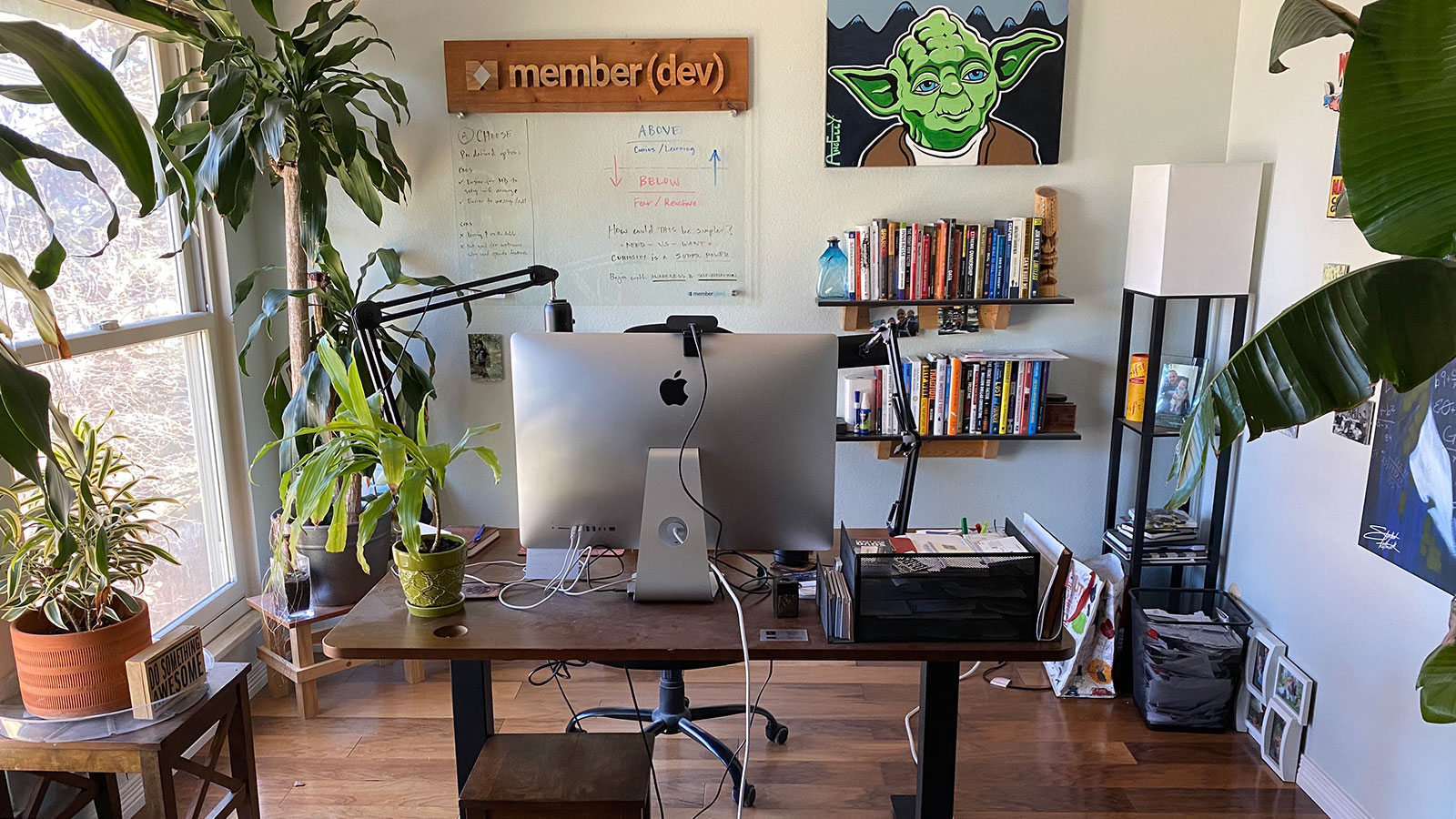
Designing Your Work Environment

Designing your work environment can be a powerful tool to fuel creativity and productivity in your daily work.

What does this mean exactly?

It’s actually quite simple.  Create the environment that you want to work in.  Make this environment reflect your core values and become a place that you want to spend time in.  A place where you are enabled to do your greatest work.

For me, it’s currently my home office.  My top core values are freedom, nature and curiosity.  Here are a few things I’ve done in my home office to reflect those values.

Freedom
  • I have pictures of family and travel on my walls and desk.  These pictures remind me of why I’m an entrepreneur.  Why I step into this office almost every day.
Nature
  • I’ve intentionally surrounded myself by plants.  I have 5-6 plants of various size and species.
  • My desk, floor and furniture are made from wood.
  • I want to mimic nature as much as possible in this office.
Curiosity
  • I have paintings of Einstein, Yoda and Wolverine on my walls.  These heros remind me to stay curious and play.  Life doesn’t have to be so damn serious all the time.
  • I keep a couple shelves of my favorite books right behind my desk so I can easily remind myself of knowledge that satisfied and further peaked my curiosity.
  • I also have various quotes on my whiteboard and furniture.  One quote in particular – “Curiosity is a superpower.”  I firmly believe that.

Your environment can also reflect the tone or vibration you want to set.  Some people are serious and extremely driven by accomplishment, so you’ll see awards and accolades on their walls to fuel that drive.  Others might be minimalist, so you’ll see virtually nothing in their space which brings them the peace they need to feel centered.

You can take this to the next level with variance and proximity. For example:

  • Some people change their environment by getting out to a coffee shop or shared work space once or twice a week. This can offer nice diversification to fuel additional creativity and productivity.
  • Some people work remotely from different countries for periods of time. Same concept with additional impact. Put yourself in a brand new environment to see what it might unlock.

Regardless, the important piece here is to be intentional about how you design your environment.  Most of us spend a fair amount of time working so why wouldn’t we optimize our time in this space?


business transparency

The Value of Transparency in Business

Transparency – one of the strongest, most used terms in business today. The condition of being transparent, which by definition means, “made visible by light shining through.”

Transparency in business has become a standard by which we define ourselves in how we communicate, negotiate, and operate. For this reason, businesses in all industries are starting to claim transparency in some form or fashion. Let’s dive into some examples.

Examples of Transparency

Fashion

Some organizations go to great lengths to reveal the cost and location of where their goods are produced. While this might seem foolish or even stupid, this has become very popular in the fashion world as consumers become more concerned with labor laws and materials. People place much higher value on this than they did 10 or 20 years ago… so think twice before you slap a “Made in China” sticker on your product and call it a day!

Food

In the food industry, transparency comes in the form of delivering fresh, local products whenever possible. Restaurants and grocery stores alike are making these efforts as consumers become more aware of health and environmental factors. In fact, it’s hard to find a burger joint in Denver that DOESN’T offer local meat and produce.

Tech

The tech community also promotes strong transparency through “open-source” projects, in which code and proprietary information is released for public use. Can you imagine that??? Giving away the thing you’ve built for free!?! As crazy as it sounds, this is very popular among developers and one of the main reasons technology continues to evolve faster than most industries. Even Elon Musk, one of the world’s greatest tech moguls and entrepreneurs, decided to open-source the designs for Tesla’s electric cars.


Why you should consider Transparency

Aside from the examples above, being transparent has immeasurable value. Below are some benefits of being transparent and/or working with other businesses that promote transparency.

1) Clean Reputation

By being transparent, you’ll create a reputation backed by honesty and integrity. This can go a long way for any business, especially in an internet dependent world where people have instant access to reviews and ratings. Keeping a clean reputation is essential to success, both online and offline, as it helps you build and nurture future relationships.

2) Better Communication

We’re all human, and being human requires that we communicate with each other to get things done. When people are open and honest with their communication, things get done faster and more efficiently. Lying and stretching the truth will only disrupt your communication channels and/or waste time… and time is not something you can get back!

3) Smoother Sales

When the terms of a sale or deal are clear they tend to move faster. Why? Because people make decisions after they have all the information they need. By being transparent up front, you expedite the process of a sale or negotiation. Furthermore, you avoid any potential delays or second guesses that might arise from hidden information – i.e. a lost deal or a return.


How We Embrace Transparency

Those are just a few of the many benefits gained from being transparent. At Creatency and member(dev), we strive to be transparent in everything we do, from messaging and sales to technical development. In fact, we’ve even been cited as being too transparent! However, we take that as a compliment 🙂

As a result of being transparent, we’ve built some great client relationships over the years. We’ve even pushed our transparency onto our clients in how they market their products and services online.

For example, we specialize in membership sites that offer paid subscriptions. All of our sites have seen continued success from a clean and open sign up processes – providing users with upfront pricing, terms and instructions. While this may seem obvious, a lot of membership sites on the web actually do the opposite by hiding terms or tricking users with deceptive and “salesy” offers.


How about you? Are you being transparent in how you do business? If not, hopefully you can take something valuable away from this article.

Great Projects Start with Great Questions

Great projects don’t happen overnight. In fact, they often don’t happen over a week, or even a month! They’re the result of thorough planning, solid execution, and disciplined testing. But before all that good stuff, great projects start with great questions.

Below are some tips and advice to help you ask the right questions before launching a project.


Basic Questions as a Starting Point

Many professionals and agencies in service industries are always eager to jump right into a project, assuming they’ve got enough experience and smarts to “run with it.” In many situations they can, and the accelerated approach will result in a mediocre deliverable. This is how most agencies operate. They crank through projects with some systems in place and deliver sub par outcomes.

What distinguishes a good project from a great project are the questions that get asked before any work starts. At Creatency, we always start our initial conversations with some basic questions, regardless of the type of product we’re building.

For example:

  • How does your business currently operate?
  • How do you make money?
  • Who are your best customers and where do they come from?
  • What core features or content do your customers value most?
  • What things could be done by a computer instead of a human?

I know what you’re thinking, “These are pretty general questions… aren’t they obvious?” No. You’d be surprised how many websites and applications get launched with poor user experiences and functionality. Why? Because the creator of the product didn’t really understand their client’s business model.

The Added Value

Asking basic questions also forces your client to reconsider things that they may frequently take for granted or overlook. It shows them that you care about their business, and are putting the time/effort in to fully understand their business so you can produce the best product possible. This will add immeasurable value to your relationship, especially with the good clients that identify the intentions behind your questioning and research.

Furthermore, asking great questions doesn’t only apply to planned projects. In some situations, asking questions may actually spark a project, or influence a client to think about a new product offering. So take advantage of every opportunity to better understand your clients and their operations.


Example

One of our clients [and friends] is a big player in the insurance industry. We help them will all sorts of digital needs. They happened to be in Denver for business a while back, so I decided to meet up for a beer and some laughs. In the midst of our conversation we ran into discussion of their sales process – managing their leads and agents. After asking a few questions and thoroughly understanding their process, I made some suggestions on how technology might improve their workflow.

A couple weeks later I got a call to put a proposal together for a new lead application, and days later we had a new project in the pipeline. This happened organically by asking the right questions.


Bottom line

Ask questions and put the extra effort in to knowing your clients’ businesses. It may happen the first time you meet them, before a project starts, or even at a happy hour. Regardless, it will yield better products and ultimately add value to your business relationship.